
On Wednesday, March 11, 2026, Instem experts Chris Nichols, Senior Director, and Breac Baker, Product Manager, led a live webinar titled “Advanced Colony Management with Climb”. This webinar demonstrated Climb’s colony management functionality, showing how common challenges faced by researchers, and husbandry and veterinary teams can be overcome by the modernized and integrated approach built into Climb for managing every aspect of vivarium operations. Below is a recap of that demonstration.
What Can Climb Do?
Climb is a cloud-based platform designed to manage preclinicalin vivo studies from start to finish. It centralizes study design, scheduling, animal tracking, and data capture into a single system, replacing fragmented tools such as spreadsheets. The software enables teams to plan experiments, assign and adjust tasks dynamically, monitor animal health, and record data with full traceability. By automating workflows and integrating with lab systems, Climb improves efficiency, data accuracy, and compliance. It also supports collaboration across research, veterinary, and operational teams, providing real-time insights and standardized reporting to help accelerate decision-making and scientific outcomes. In this webinar recap, the focus is on core Climb modules that support effective colony management.
Animal Management – Orders, Intake, and Housing
During the webinar, Chris and Breac examined how Climb can efficiently manage animal operations, from order placement to housing. Preclinical laboratories often utilize fragmented systems, such as emails or spreadsheets, to retain order details, and animal intake and housing are often conducted without a unified workflow. These systems create information silos that can lead to mistakes, including the deletion of critical data.
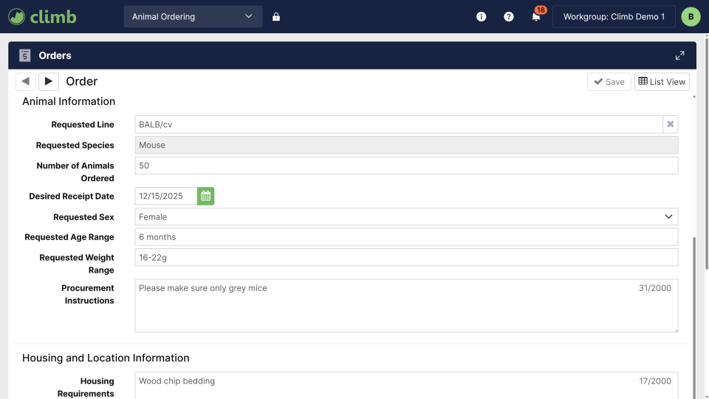
With Climb, users can utilize the “Orders” facet to centralize order data, enforce required fields, and control form access. Users can simply navigate to the “Orders” facet by going to the “Animal Ordering” dashboard, where they are greeted by two tabs: “Orders” and “Animals”. As shown below, users accessing the “Orders” form can view a variety of essential information, such as order ID, order status, and requested parameters (e.g., species, animal line, sex, age, and weight range). Users may also view procurement information such as PO number, date ordered, projected receipt date, and log the receipt of animals when they arrive.
Using the “Animals” facet, teams can skip laborious data input by bulk-adding animals, where they can also autopopulate metadata and assign housing all in one view. With this function, newly added animals can be tied to existing order IDs. Teams can input and securely store information such as breeding status, sex, origin, shipment, arrival date, birth date, study name, and genotype. Housing units can be easily created and managed, as users can assign the number of animals per unit, document the owner, housing type, container type, and location.
These processes standardize animal ordering and streamline intake and housing, effectively eliminating the risk of duplicate data entry, housing errors, and ultimately reducing the labor required to update and maintain this essential animal management information.
Ensuring Quality, Coordination, and Reporting
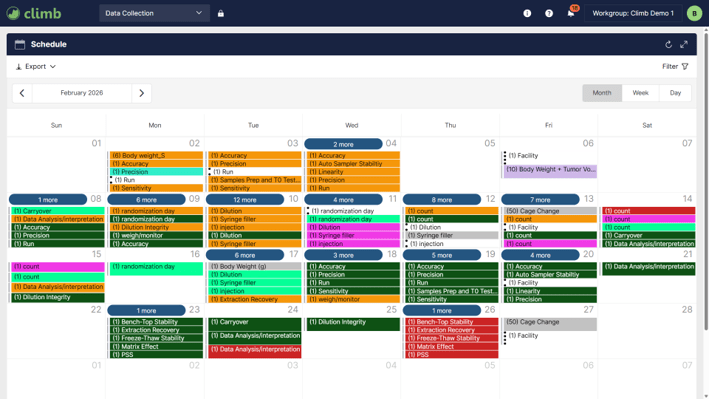
Climb is designed to improve daily data quality and operational efficiency in preclinical research environments. The webinar highlighted how the “Data Collection and Workflow” dashboard in Climb, depicted below, can be used to overcome common problems across quality, coordination, and reporting. These include:
- Data quality: Where traditional spreadsheets lead to inconsistent data and extra administrative work, Climb centralizes records and structures tasks with the “Workflow” feature, allowing tasks to be named, task status to be viewed, deadlines to be set, and specific personnel to be assigned.
- Workflow coordination: Daily workload planning across teams can be chaotic and lack clarity, but the Climb “Schedule” facet enables color-coded task assignment by person, team, or equipment. As tasks are completed, the task status will update and document who completed the task and when.
- Measurement capture: Collecting and accessing baseline data across colonies and studies can be time-consuming. However, Climb supports hands-free data collection by integrating with instruments and centralizing measurement tasks.
- Reporting: Clinical concerns need to be reported quickly, but this can be challenging in a busy vivarium. Using the “Clinical” feature, Climb users can document clinical observations and animal status, notify vets, and create treatment tasks in one workflow. They can also mark certain observations as “urgent” to send an urgent clinical alert message to individuals or groups of users, such as veterinary teams.
- Animal history: A complete animal history is difficult to compile with disconnected tools. With Climb, the “Journal” feature within the “Animals” facet consolidates life cycle events, giving historical information on each animal as well as important metrics such as body weight with time and clinical observations, all of which can be quickly exported to PDF format.
By providing these functions, Climb improves animal welfare and scientific decision-making by reducing data inconsistencies, minimizing time spent reconciling spreadsheets, and increasing efficiency through better data access, task visibility, and balanced workloads. The platform also enhances traceability and response times, reducing clinical delays and costs while strengthening coordination across research, husbandry, and veterinary teams
Complete Management of Breeding Operations
In the final showcase of colony management within Climb, Chris and Breac demonstrated how Climb can be utilized to modernize breeding workflows, visualize lineage, and view breeding performance. For organizations that choose to breed animals, breeding can become complex when data is siloed across fragmented systems that are often managed manually. This makes it laborious and time-consuming to track breeding history and performance.
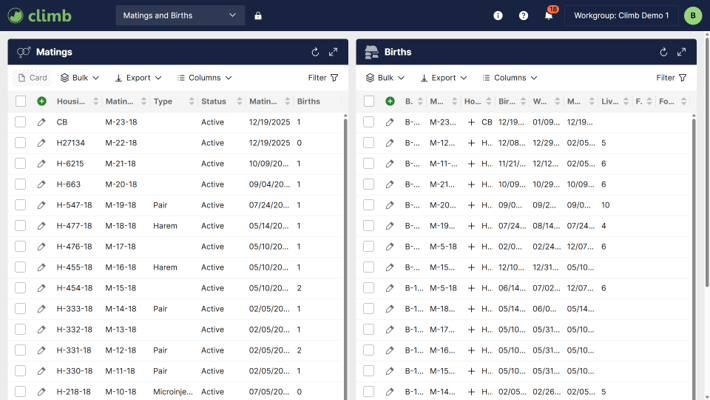
Using Climb, users can simply navigate to the colony management dashboard. Here, “Matings” and “Births” facets capture breeding history, support quick newborn entry, and integrate breeding workflows. Teams can easily view information such as IDs, birth dates, wean dates, live born count, mating dates, number of births, and add any associated IACUC protocols. Pedigree and efficiency charts show lineage, genotype context, and breeding metrics. Users can also access “Animals” and “Housing” facets, unifying critical animal data. Using these solutions, research and animal teams can streamline workflows and analyze data quickly and easily to support better, more efficient decision-making.
Coming Soon: Provantis and Climb Colony
The webinar also featured an exciting announcement: the connection of Climb to Provantis. This will enable comprehensive quality management data from one centralized location, with colony management data from Climb flowing into Provantis. More details will be provided in the future.
Conclusion
Climb supports robust animal management, from breeding strategies, pedigree visibility, cage assignments, and essential housing logistics, to adverse event tracking and real-time veterinary alerts to promote animal welfare. All of this is within a structured, role-based platform designed to reduce errors and maintain reliable, auditable records. This recap is only a short summary of the capabilities of Climb. To understand more about the full capabilities of this solution, experience live demonstrations, and access a valuable Q&A session, watch the full webinar or book a free demo to explore how Climb can transform colony management for your team.