
On October 10, 2026, experts from Instem will join industry and academic specialists from across India in Pune to discuss the future of toxicologic pathology and preclinical research. The workshop will combine expert-led talks with networking opportunities, tours of Instem’s offices, and a hybrid Q&A session bringing together perspectives from both the local and global toxicology communities.
NAMs and the Future of Preclinical Toxicology
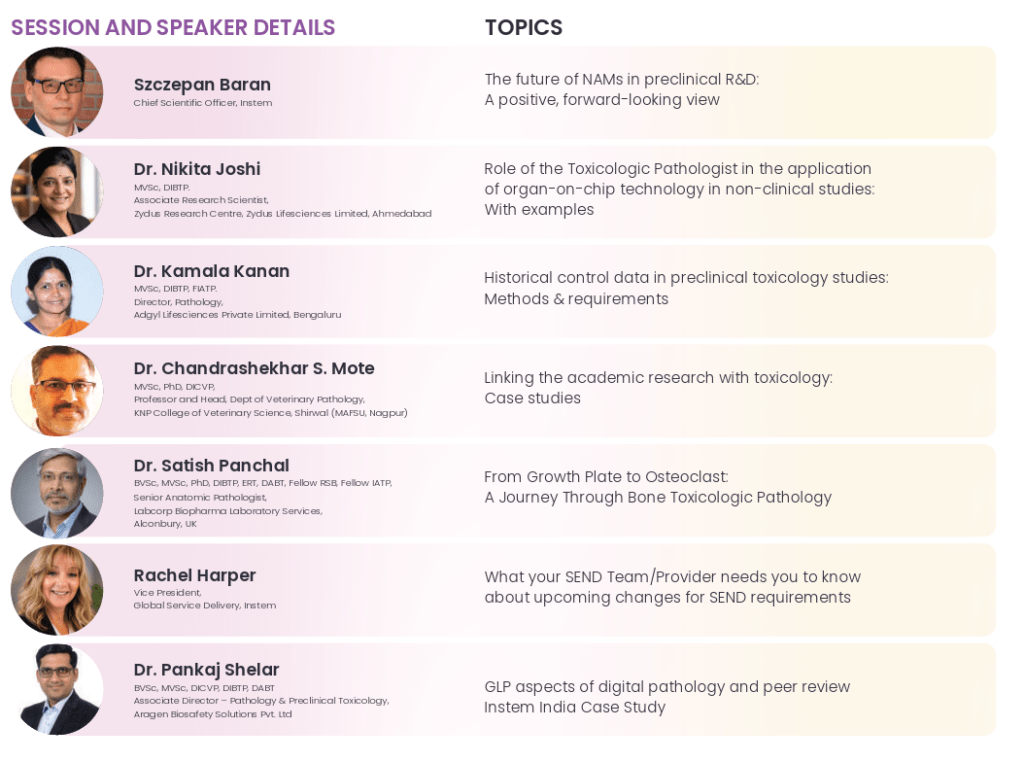
The keynote address, delivered by Szczepan Baran, Chief Scientific Officer at Instem, will explore the promise of New Approach Methodologies (NAMs) and their potential to reduce reliance on animal testing through more human-relevant approaches. NAMs are becoming increasingly important as regulatory bodies place greater emphasis on alternatives to traditional animal models, including technologies such as organ-on-chip systems, for generating evidence during drug development. This shift has gained momentum following regulatory developments such as the FDA Modernization Act 2.0, enacted in late 2022, which removed the longstanding requirement for animal testing to support all new drug applications1. The talk will consider what the growing adoption of NAMs could mean for preclinical R&D in the coming years.
The Evolving Role of Toxicologic Pathologists
Following the keynote address, Dr. Nikita Joshi, Associate Research Scientist at Zydus Lifesciences, Ahmedabad, will explore the use of organ-on-chip technologies in nonclinical work. Drawing on case studies, Dr. Joshi will illustrate the practical implementation of this increasingly prominent NAM and its potential applications in preclinical research. As these technologies become more widely adopted, toxicologic pathologists will need to expand their expertise to interpret findings generated by new experimental platforms. Dr. Joshi’s presentation provides a timely link between the forward-looking vision explored in the keynote address and the practical realities of implementing NAMs at the bench.
Historical Control Data
Historical control data provide pathologists with an important baseline against which new findings can be evaluated. However, as new technologies are introduced into preclinical studies, comparisons with historical datasets generated using different techniques can become increasingly challenging. Dr. Kamala Kanan, Director of Pathology at Adgyl Lifesciences, a preclinical CRO based in Bengaluru, will explore these and other considerations in her talk. Drawing on her experience, Dr. Kanan will discuss the methods and requirements for using historical control data in preclinical research.
The Importance of Digital Pathology
Digital pathology is becoming increasingly embedded in the generation and evaluation of preclinical evidence, with whole-slide imaging offering important advantages over traditional glass-slide workflows. As adoption grows, however, laboratories must navigate a range of practical, technical, and regulatory considerations2. Dr. Pankaj Shelar’s talk, “GLP Aspects of Digital Pathology and Peer Review,” will explore these challenges and provide practical guidance on aligning digital pathology workflows with GLP expectations. Dr. Shelar, Associate Director of Pathology & Preclinical Toxicology at Aragen Biosafety Solutions, will present an Instem India case study illustrating how these regulatory principles translate into day-to-day practice within an Indian preclinical CRO.
The session will be followed by a demonstration of slide scanner integration with Instem’s Provantis Pathology Module. This will showcase recent advances enabled by PathcoreFlow™, developed by Instem’s strategic partner Pathcore®, and demonstrate how high-resolution digital slide review can be incorporated seamlessly into core study management workflows.
Staying Up to Date with SEND
Rachel Harper, Vice President of Global Service Delivery at Instem, will provide an update on upcoming changes to SEND requirements, a critical consideration for ensuring that nonclinical study data meet FDA standards. A key development is SEND v4.0, which has completed public review and could become mandatory as early as 2029-2030. Although implementation may still be several years away, teams should begin preparing now by understanding the new requirements and aligning their practices accordingly. Rachel’s session will outline what is changing and the steps organizations can take today to prepare for future compliance.
Practical Insights
Many advances in drug discovery originate in academic research, but translating these insights into preclinical practice requires an understanding of the distinct requirements and challenges of both environments. Dr. Chandrashekhar S. Mote, Professor and Head of the Department of Veterinary Pathology at KNP College of Veterinary Science, Shirwal (MAFSU, Nagpur), will share his perspective on bridging academic research and toxicology workflows, exploring how scientific insights can be translated into practical applications.
Dr. Satish Panchal, Senior Anatomic Pathologist at Labcorp Biopharma Laboratory Services in Alconbury, UK, will complement this perspective with his talk, “From Growth Plate to Osteoclast: A Journey Through Bone Toxicologic Pathology.” Through this focused case study, Dr. Panchal will illustrate how a detailed understanding of developmental biology can support the accurate interpretation of bone-related findings in preclinical safety studies.
Register Today
This workshop reflects a field on the verge of significant change. NAMs, organ-on-chip platforms, and digital pathology are set for greater integration in preclinical toxicology. Attendees will gain grounded, expert perspectives on navigating these shifts, develop insights into SEND v4.0 readiness and cross-disciplinary practice, and build connections across India’s growing preclinical research community.
Register today to secure your place.

References
1. Zushin PJH, Mukherjee S, Wu JC. FDA Modernization Act 2.0: transitioning beyond animal models with human cells, organoids, and AI/ML-based approaches. J Clin Invest. 2023;133(21):e175824. doi:10.1172/JCI175824
2. Forest T, Aeffner F, Bangari DS, et al. Scientific and Regulatory Policy Committee Points to Consider: Primary Digital Histopathology Evaluation and Peer Review for Good Laboratory Practice (GLP) Nonclinical Toxicology Studies. Toxicol Pathol. 2022;50(4):531-543. doi:10.1177/01926233221099273