Features of a Manufacturing Flow
All manufacturing processes, whether producing cars, pipes, medical devices, or pharmaceuticals, begin with raw materials that are transformed through a series of steps into a finished product. In pharmaceutical production, the constituent components typically include the active pharmaceutical ingredient (API), excipients, and packaging and labeling materials. Tablets, for example, may include coating agents to make them easier to swallow and coloring agents to distinguish them from others.
These tablets are often packaged in blister packs of around twenty units, placed in cardboard cartons printed with key consumer information. As with the manufacture of cars or even ice cream, every component—from the API to the foil of the blister pack—must be traceable back to the originating batch from each supplier. When multiple batches of the same material are used, each must be documented as part of the production record.
The key is traceability—ensuring that every material used in the manufacture of a product can be traced throughout the entire production process.
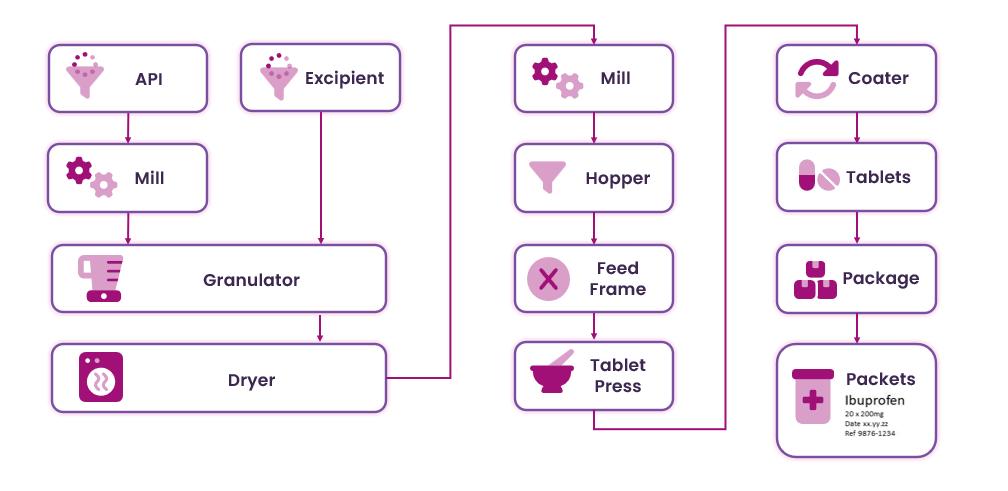
An overview of a typical pharmaceutical tablet production line is shown in Figure 1. Much like cooking, the precise proportions of the various raw ingredients are controlled by a recipe that defines the required amounts of the API and excipients. The ingredients are milled and mixed to ensure an even distribution of the API. Mixing may be performed as a slurry or wet mix, which is then dried and milled again to produce a fine powder. This bulk powder can be blended with additional excipients before compressing into tablets using a tableting machine. The tablets may then be coated and packaged as required.
Testing is conducted at each critical stage of the process—from raw materials to the final packaged product. For example, incoming raw materials may be retested to confirm they meet the supplier’s specifications before being released for use. The granulator output may be analyzed to verify uniform API distribution, while the milled material is checked to ensure it maintains the correct API proportions and particle consistency. Samples of the finished tablets are retained for dissolution, stability, and other quality assurance testing.
Requirements of a Pharmaceutical Manufacturing LIMS
All LIMS require the ability to track samples and associate test results, create certificates of analysis (CofA), use barcoding, and associate samples with key information such as batch and supplier. LIMS will also include the ability to manage calibration and maintenance of laboratory instruments and records of which instruments were used for each sample test, along with who tested that sample and whether they were competent to test it, and to control inventory of the chemicals and the laboratory consumables used in testing.
But while a typical QC sampling flow monitors and reports on discrete samples, a manufacturing flow requires a broader range of information to be associated and combined for management and reporting. A manufacturing flow requires the addition of Recipe Management to control the raw materials and intermediate products going into each manufacturing batch; the ability to keep test results for each part of the flow (raw materials, intermediate stages and final product); the ability to link test results to the originating raw materials/suppliers and final product/customers; the statistical tools to control the process within defined limits; and the ability to quickly retrieve and report on this data.
Key parts of a pharmaceutical manufacturing LIMS include:
- Specification Management
Defines and manages the specifications of Raw Materials (RM), Intermediate Products (IP), and Finished Products (FP) to ensure compliance with required standards. - Recipe Management
Outlines the components and quantities required to produce each product according to validated formulations. - Batch Management
Tracks and manages RM, IP, and FP batches throughout the manufacturing process, ensuring complete traceability and control. - Batch Genealogy
Establishes relationships between raw materials and final products, enabling full traceability of which batches were used in each product. - Manufacturing Sample Management
Defines batch and sample templates, including associated tests required for RM, IP, and FP analysis. - Material and Inventory Management
Monitors the inventory of physical samples collected during manufacturing, as well as laboratory consumables, reagents, and chemicals. - Supplier Management
Maintains detailed records of suppliers for materials, reagents, consumables, and raw ingredients to support compliance and audit readiness. - Instrument Calibration and Maintenance
Schedules, tracks, and records calibration and maintenance of laboratory instruments, ensuring only validated and compliant equipment is used for testing. - Competency and Training Management
Maintains staff training and competency records, automatically restricting task assignments to qualified personnel. - Method Management
Organizes and manages analytical test methods to ensure consistency and regulatory compliance. - CAPA (Corrective and Preventive Action)
Supports continuous quality improvement through systematic management of corrective and preventive actions. - Skip Lot / Selective Testing
Implements reduced testing rules (e.g., test every 20 batches after five consecutive passes) to optimize efficiency while maintaining compliance. - Work Assignment
Allocates analysts and instruments to specific tests, ensuring balanced workloads and optimal resource use. - Runsheet Management
Generates analytical run sheets that define sample test sequences, including blanks, standards, and duplicates. - Instrument Integration
Connects directly with analytical instruments to automate data transfer, reducing manual entry and improving accuracy. - External ERP Interface
Integrates seamlessly with enterprise systems (e.g., SAP) for the import of inspection plans and lots and the export of batch usage decisions and analytical results. - Product Grading
Facilitates the grading or classification of products based on test results and defined quality criteria. - Chain of Custody
Maintains a complete record of a sample’s custody, including its location, handler, and status throughout the testing process. - Certificate of Analysis (CoA) and Certificate of Conformance (CoC)
Automates the generation and management of CoAs and CoCs to support regulatory submissions and customer requirements. - Advanced Analytics
Delivers actionable insights on product conformance, laboratory performance, supplier reliability, and material variation. - Stability Testing
Manages stability study workflows to assess and document the retention of product quality over time for shelf-life determination.
Driving Simplicity
Pharmaceutical manufacturing workflows require an additional layer of complexity built upon a general QC LIMS framework. This ensures the effective management of batches—from creation through to the delivery of a final Certificate of Analysis (CoA)—produced to known and repeatable standards through specification and recipe management and tested in accordance with defined sample management procedures.
All the usual sample testing with accept/reject/re-test gating remains essential, but with the added challenge of tracking batches of raw product (RP), in-process product (IP), and finished product (FP). These must be associated in such a way that, in the event of a recall or audit, it is possible to trace precisely which raw materials were used in which product batches—and vice versa. Such traceability is a critical requirement in regulated industries like pharmaceutical manufacturing, where compliance with FDA 21 CFR Part 11, EU Annex 11, ISO 17025, ISO 9001, and cGxP standards is mandatory.
The predefined Matrix Gemini LIMS Pharmaceutical Manufacturing System is designed to meet these strict regulatory requirements while maintaining flexibility. Every pharmaceutical manufacturing workflow has its unique challenges, which is why Matrix Gemini LIMS is built on a configurable platform that does not require custom code or HTML modifications to the core software. Its unique configuration tools allow users to modify workflows, screens, and menus within the starter system without programming changes.
This design enables rapid revalidation of the starter system using supplied IQ and OQ scripts, which can be easily updated to reflect any configuration changes. The result is significant time savings, faster implementation, and reduced costs, helping you bring your products to market more efficiently.
Another key advantage of this configuration approach is that the underlying software remains unchanged, simplifying future upgrades and allowing you to benefit from new enhancements and extensions as they become available. For users who wish to manage their own configurations, we offer a comprehensive three-day training course. You can make changes without invalidating your support agreement (unlike with many other LIMS vendors) and can contact our support desk directly for assistance, even sharing specific screens for review if needed.
The powerful configuration tools in Matrix Gemini LIMS give your Manufacturing LIMS the edge—driving efficiency, maintaining compliance, and reducing lifetime costs.
Since many of these features are applicable across all manufacturing industries, Instem’s Pharmaceutical Manufacturing LIMS provides a robust foundation for any production environment, whether manufacturing cars, food, electronics, or pharmaceuticals.
For further information or to request a demonstration, contact us today to learn more about Matrix Gemini LIMS.