In this recap, we’ll cover the challenges associated with 21 CFR Part 11 compliance, the hidden costs of non-compliance, and how Compliance Builder and eQCM help laboratories identify, manage, and close gaps across the full data lifecycle.
On Wednesday, June 3, 2026, Christopher Buska, Senior Product Manager at Instem, led a live webinar titled: “Closing Compliance Gaps with Compliance Builder,” showcasing how organizations can better manage compliance under 21 CFR Part 11. Comprehensive electronic recordkeeping is a cornerstone of all laboratory functions in regulated industries, but establishing and maintaining 21 CFR Part 11 compliance is challenging when processes are fragmented across multiple instruments, systems, and geographies. This recap highlights key themes from the webinar, including how Compliance Builder and electronic Quality Control Management (eQCM) from Instem support data integrity, security, and traceability for a more robust, inspection-ready approach to compliance.
Why 21 CFR Part 11 Remains a Challenge
21 CFR Part 11 is a framework set out by the FDA that sets expectations for electronic records and electronic signatures in regulated environments. Within this, labs must evaluate whether their systems can support key requirements regarding data integrity, audit trails, validation, security and operational controls, data retrieval, and electronic signatures. Although organizations typically understand the requirements under 21 CFR Part 11, it can be difficult to identify where compliance gaps already exist or where new risks may arise.
This is especially relevant for large organizations managing multiple systems and instruments, each with its own data management capabilities. For organizations transitioning from written to digital documentation or integrating legacy systems, meeting every compliance requirement across all systems can be challenging, if not impossible. Fragmentation leaves teams exposed to potential compliance gaps and the associated consequences.
Hidden Costs of Non-Compliance
During the webinar, Christopher outlined several hidden costs associated with loss of compliance, many of them linked to instrument downtime. A particularly striking statistic he highlighted is the approximate $100,000 cost associated with downtime of a single flow cytometer per week. Additional costs can include the loss of critical samples or reagents, repeat experiments that consume further resources and staff time, and delays to project timelines. The FDA may also publish any findings and issue fines, leading to lasting reputational damage and reduced sponsor confidence.
Introducing Compliance Builder
Christopher explored the core functions of Compliance Builder, a purpose-built tool from Instem for identifying and closing 21 CFR Part 11 compliance gaps.
Real-time data file monitoring is central to Compliance Builder’s functionality, providing comprehensive coverage across diverse file types and compatibility with virtually any data hosted on a Windows system. This includes:
- Instrument data output
- Instrument templates, recipes, and configuration
- Instrument logs and reports
- Excel, Word, PDF files
- SAS, CSV datasets
- Image files
- Training records
- Access, MS SQL, Oracle database records
User-defined paths and file selections allow organizations to tailor compliance monitoring to their specific needs, without creating inefficiencies by tracking files that do not require GxP-level oversight. Compliance Builder captures file creation, modification, and deletion events in addition to electronic signatures, and additional security controls such as Screen Locks.
A core benefit of Compliance Builder is data centralization. By consolidating data and version tracking, it not only helps teams maintain compliance across fragmented infrastructure but also provides a simple, secure way to browse, download, and compare file versions from a single platform.
The webinar also covered a case study of a US-based Fortune 500 company that has used Compliance Builder for over a decade to support 21 CFR Part 11 compliance across more than 400 workstations. This enduring trust from an industry leader highlights the platform’s ability to scale successfully across large, complex laboratory environments.
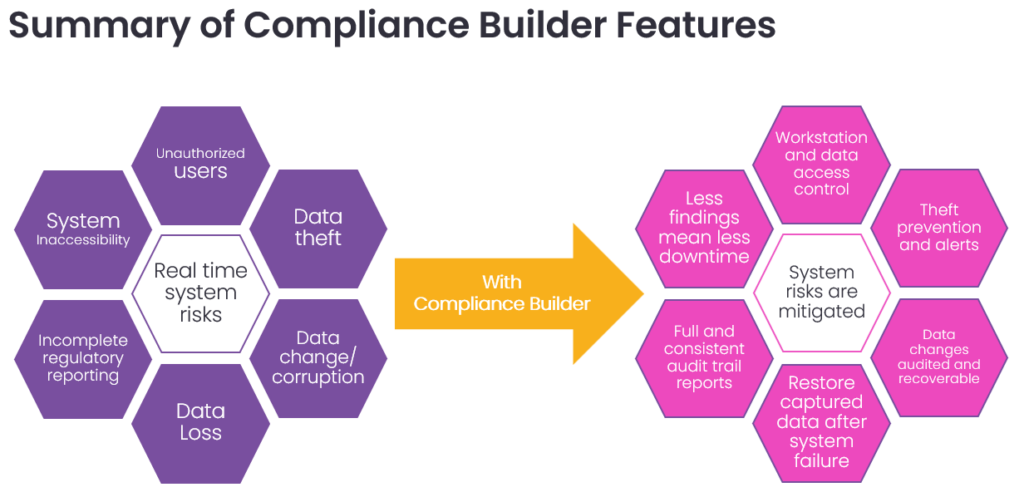
Closing the Compliance Loop
The webinar touched on a critical factor that teams may overlook when working toward lasting compliance. While Compliance Builder supports the identification and control of compliance gaps, additional quality processes are needed before an issue can be considered fully resolved. Achieving this without a structured, traceable approach can leave teams vulnerable to further compliance gaps and create significant challenges during regulatory audits, even when their data monitoring systems are comprehensive.
This is where Instem’s eQCM comes in. After Compliance Builder identifies a gap and generates the supporting evidence, eQCM helps close the compliance loop by providing a centralized system for managing related quality processes, including Corrective and Preventive Actions (CAPAs), audit management, incidents, nonconformances, and other quality events.
The webinar concluded with a concrete example of how Compliance Builder and eQCM work together to support the full 21 CFR Part 11 compliance lifecycle, from identifying gaps to formally closing quality events. This is achieved across four core functions:
Identify: Compliance Builder monitors laboratory files and folders in real time to identify gaps such as unauthorized access, missing audit trails, shared logins, or uncontrolled file changes.
Capture: Once an issue is identified, QA teams can formalize it in eQCM, linking the quality event directly to the audit trail evidence generated by Compliance Builder.
Remediate: Compliance Builder helps apply technical controls, such as secure logins, electronic signatures, approved application access, and deletion prevention, while eQCM documents the remediation process.
Close: eQCM supports review, approval, electronic signature, and formal closure, creating an inspection-ready evidence package that links the original finding to the investigation, corrective action, and final resolution.
Conclusion
The webinar highlighted that effective 21 CFR Part 11 compliance depends on more than understanding the requirements and monitoring data. Laboratories need reliable ways to identify risks across large laboratory networks, preserve evidence, apply corrective controls, and document final closure. Compliance Builder and eQCM support this end-to-end process by connecting real-time data monitoring with structured quality management. Together, they help organizations reduce compliance risk, improve audit readiness, and maintain greater control across complex laboratory environments as systems, instruments, and teams continue to scale.
Download our comprehensive white paper to explore these topics in more detail, or book a free demo to learn how to achieve compliance from an expert first-hand.